
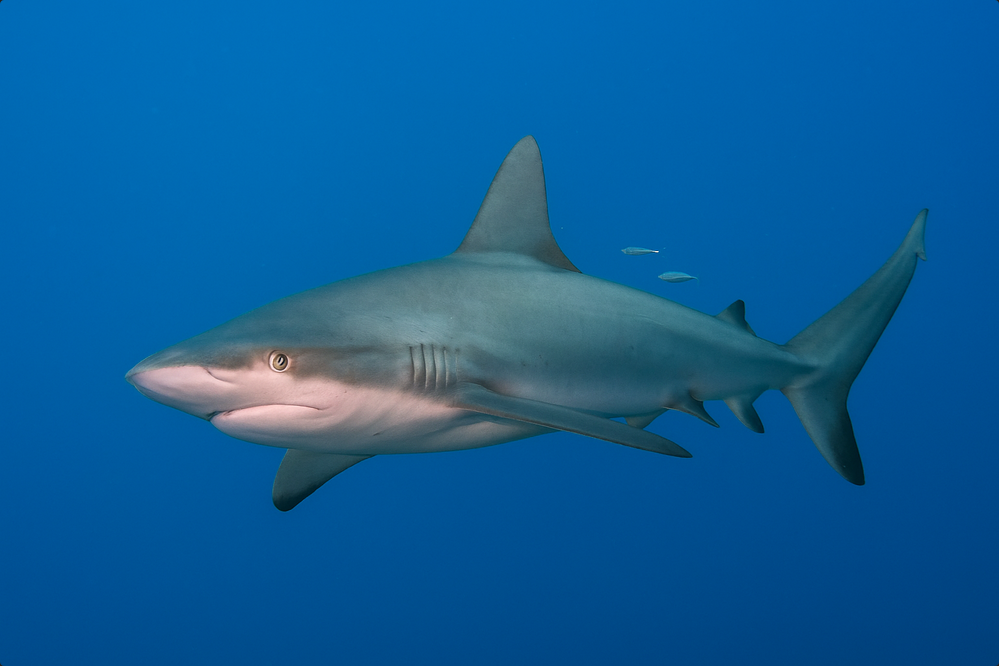
The Galapagos shark (Carcharhinus galapagensis) is one of the most iconic large sharks found across tropical oceanic islands. Known for their confident, slow-cruising behavior, they are frequently seen by scuba divers in remote archipelagos like the Galápagos, Hawaii, and French Polynesia. While commonly confused with grey reef sharks or dusky sharks, several biological and behavioral features set this species apart and help divers identify them with confidence.
What Makes the Galapagos Shark Unique
Galapagos sharks are among the largest coastal-pelagic requiem sharks, with adults typically measuring 3–3.3 m (10–11 ft) and occasionally exceeding 180 kg (400 lbs). Their bodies are visibly thicker and more muscular than most reef-dwelling sharks. This extra mass allows them to hold position in strong currents – an important advantage in the high-energy habitats they prefer.
Distinctive Head and Fin Structure
Their broad, rounded head, deep chest, and tall, prominent first dorsal fin give them a commanding silhouette underwater. The dorsal fin sits further forward than on grey reef sharks and is noticeably taller relative to body length. Their snout is longer and more pointed compared with dusky sharks, giving them a streamlined profile suited for fast, sustained swimming.
Specialization for Remote, Oceanic Habitats
Unlike many reef sharks that stay close to protected lagoons or coral walls, the Galapagos shark favors isolated islands with steep drop-offs, deep pinnacles, and exposed outer reefs. These sharks thrive in areas with strong, predictable currents, often patrolling zones where deep ocean water collides with rising reef structures. This environment attracts tuna, jacks, barracuda, and other prey species – supporting populations of large predatory sharks.
Confident, Curious Behavior Toward Divers
A defining characteristic of the Galapagos shark is its calm but assertively curious demeanor. They frequently approach divers more directly than grey reef sharks and are known to make slow, deliberate inspection passes – a behavior not typically associated with more skittish reef species. While not aggressive without provocation, their confidence demands awareness and good diving etiquette, especially at deeper sites where multiple individuals interact.
Large Aggregations at Certain Pinnacles
Few sharks display the same tendency to gather in significant numbers around underwater ridges and seamounts. At locations like Darwin Island (Galápagos), Cocos Island (Costa Rica), and Malpelo (Colombia), divers may see aggregations of 20–50 Galapagos sharks, sometimes even more during peak current conditions. These groupings are thought to be related to feeding opportunities and social behavior tied to current flow and seasonal upwelling.
Role as Apex Predators
Galapagos sharks sit at the top of the marine food chain in the ecosystems they inhabit. They feed on:
- bony fish
- cephalopods
- smaller sharks and rays
- occasionally injured or weakened marine mammals
Their presence helps maintain a balanced population of mid-level predators, supporting overall reef health. Because they occupy a wide vertical range – from shallow reefs to several hundred meters—they serve as a critical link between coastal ecosystems and deeper pelagic environments.
Thriving in High-Energy, Open-Ocean Conditions
These sharks are typically seen in clear, deep water where currents are strong and visibility often exceeds 20–30 meters (65–100 ft). The combination of nutrient-rich upwelling, abundant prey species, and steep underwater topography makes these environments ideal. Their ability to traverse open ocean between islands also explains their distribution across widely separated archipelagos.